Flat, Metal, And Industrial Roofs

Bullhead City Commercial Roof Repair

We find and fix leaks on flat, metal, and industrial roofs for building owners and facility managers in Bullhead City, from the ceiling stain back to the failed seam.

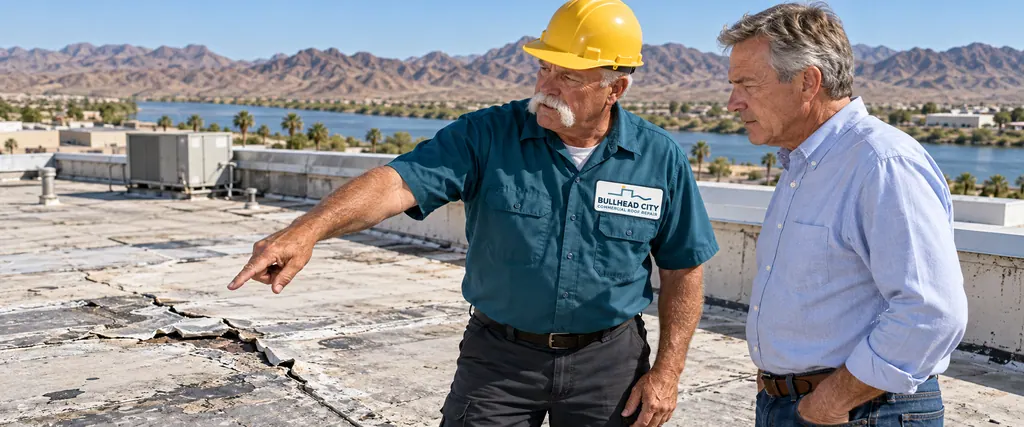
Roofer pointing out a cracked membrane seam to a building owner on a flat commercial roof in Bullhead City
  • Roofs We RepairFlat, Metal, Industrial
  • Monsoon SeasonJune 15 to September 30
  • Repair PermitsCity, County, Or Tribal
  • First StepInspect Your Roof
Where Leaks Start

Where Commercial Roofs In Bullhead City Leak First

Most commercial roof repair work starts where the membrane is cut, lapped, or turned up a wall. Long summers dry out those spots before the open field.

Roof plan sketch. Numbers match the list.
  1. Open Lap Seams

    Heat shrinks membrane and pulls at every lap. Where a seam edge lifts, we clean back to bare sheet, probe the weld or adhesive, and rebuild the lap with matching membrane and edge sealant.

  2. Packed Drains

    Blown dust and sediment collect in the strainer until water backs up around the drain bowl. Clearing it helps, yet a loose clamping ring under that debris is what lets the water in.

  3. HVAC Curb Flashing

    Sealant at curbs and pitch pans bakes hard and pulls away. Water then runs behind the curb flashing and shows up indoors, often well away from the unit itself.

  4. Parapet Caps And Wall Flashing

    Coping joints open, and wall flashing slumps as its adhesive ages. A wet stripe along the top of an inside wall usually points to this detail first.

  5. Split Pipe Boots

    Rubber and plastic boots crack in the sun right at the collar. A new boot or a flashed collar, clamped and sealed, stops the drip at that roof penetration.

  6. Ponding Rings

    Water that sits for days leaves a dirt ring and softens any patch inside it. Repairs near a low spot get extra reinforcement, and the low spot goes on the owner report.

Repair Or Replace

Repair It Now Or Plan A Replacement

Repair stays the better call while damage sits at isolated details. Once wet insulation or worn membrane covers much of the roof, a patch buys little time.

Repair Fits When

  • Leaks trace back to one seam, curb, drain, or flashing detail
  • Membrane around the leak still flexes and holds a patch
  • A core cut shows dry insulation beyond the wet spot
  • Metal panels show surface rust with no holes or soft spots
  • The roof has years left and the problem is recent

Plan A Replacement When

  • Infrared scans or core cuts find wet insulation across large areas
  • Deck steel is rusted through, or a wood deck flexes underfoot
  • Membrane is brittle and cracking across the open field
  • Leaks move to a new spot after every repair
  • The roof is close to the end of its service life
Our Services

Commercial Roof Repair Work In Bullhead City, By System

Four kinds of repair work, each tied to the roof details that fail on that system. Every card shows where repair stops and replacement starts.

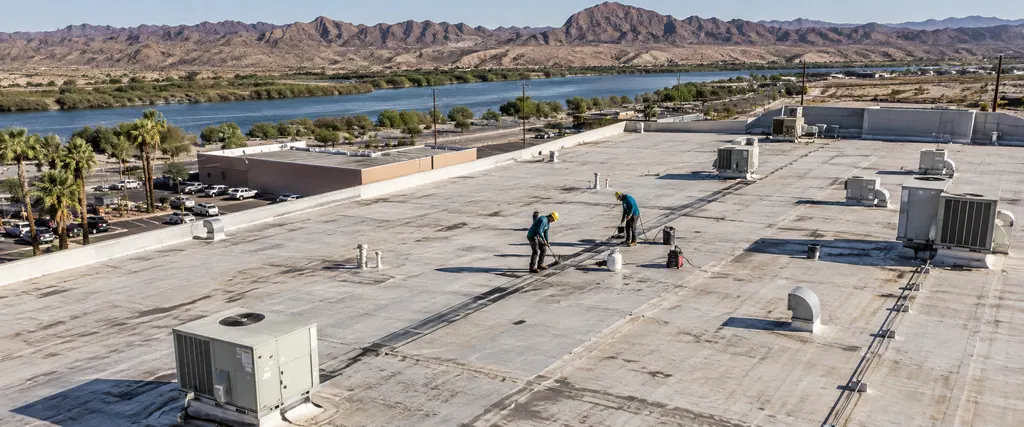
Wide view of a large white flat roof with rooftop units and two roofers working on a seam

Flat Roof Repair

Single-ply and modified bitumen roofs on retail, office, and warehouse buildings, where leaks start at seams, drains, curbs, and parapet flashing.

Common Fixes

  • Reweld or reseal open lap seams
  • Reset drain clamping rings and strainers
  • Replace split pipe boots and pitch pans
Repair Stops Here

Wet insulation under large areas, or membrane cracking across the open field.

Flat roof repair in Bullhead City
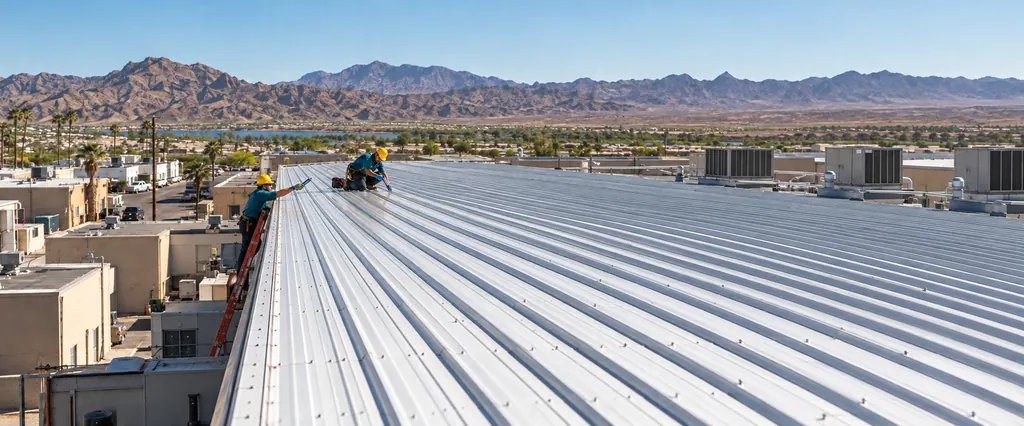
Two roofers replacing fasteners and sealing laps on a commercial metal roof

Commercial Metal Roof Repair

Exposed-fastener and standing-seam roofs on steel shops, warehouses, and storage buildings, where daily heat swings back out screws and stretch lap sealant.

Common Fixes

  • Upsize backed-out screws with new washers
  • Reseal end laps and add stitch screws
  • Prime and coat light rust bloom
Repair Stops Here

Rust holes, soft spots, or rust running along a lap call for new panels.

Commercial metal roof repair for fasteners and laps
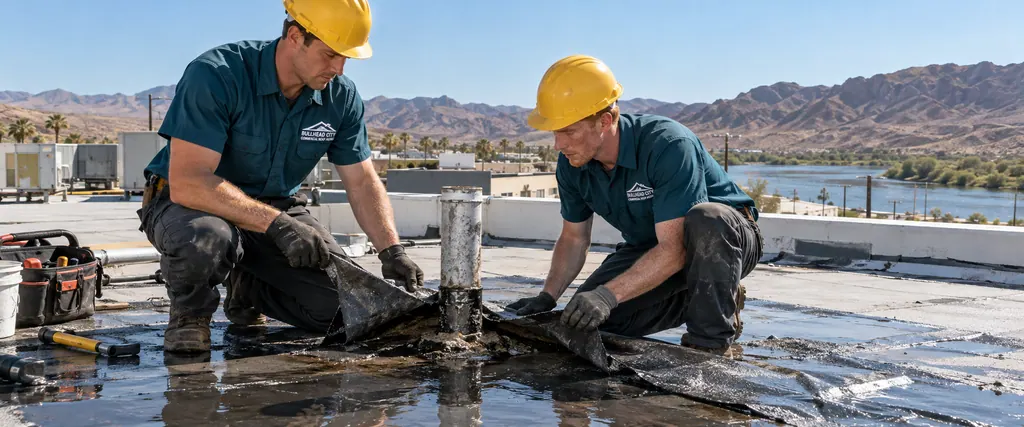
Two roofers removing a split pipe boot on a flat roof with standing water around it

Commercial Roof Leak Repair

Active leaks and ceiling stains on any commercial roof. We trace the water path along the deck, slow it, and rebuild the detail that failed.

Common Fixes

  • Trace stains back to the entry point
  • Log temporary patches for later replacement
  • Cut out wet insulation at the leak
Repair Stops Here

Leaks that keep moving across a worn roof call for a replacement plan.

Commercial roof leak repair and leak tracing
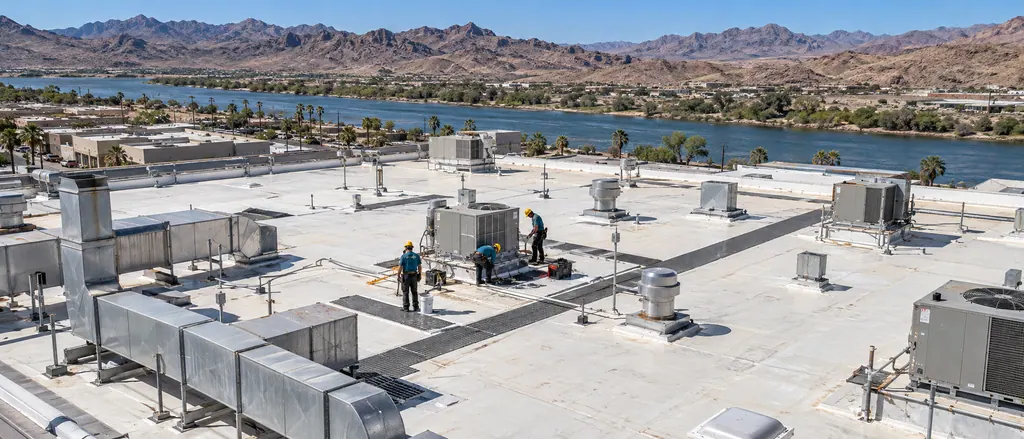
Industrial flat roof with ductwork, exhaust fans, and roofers working at an equipment curb

Industrial Roof Repair

Large roofs over production floors, crowded with exhaust stacks, makeup air units, and skylights. Work is planned around shifts so the floor below keeps running.

Common Fixes

  • Reflash exhaust fan and makeup air curbs
  • Replace cracked skylight panels
  • Add walk pads around rooftop equipment
Repair Stops Here

Deck rusted through over a work area needs structural repair first.

Industrial roof repair around exhaust and equipment

Water Dripping Into The Building?

Call now and describe where the water shows up inside. A temporary patch can slow an active leak until the roof is dry enough for a lasting repair.

Call Us
How A Repair Runs

From Ceiling Stain To Finished Repair

Each repair follows the same five rows on the work order, starting on the roof and ending with a water test.

Repair Work Order5 Steps
  1. On The Roof

    Inspect Your Roof

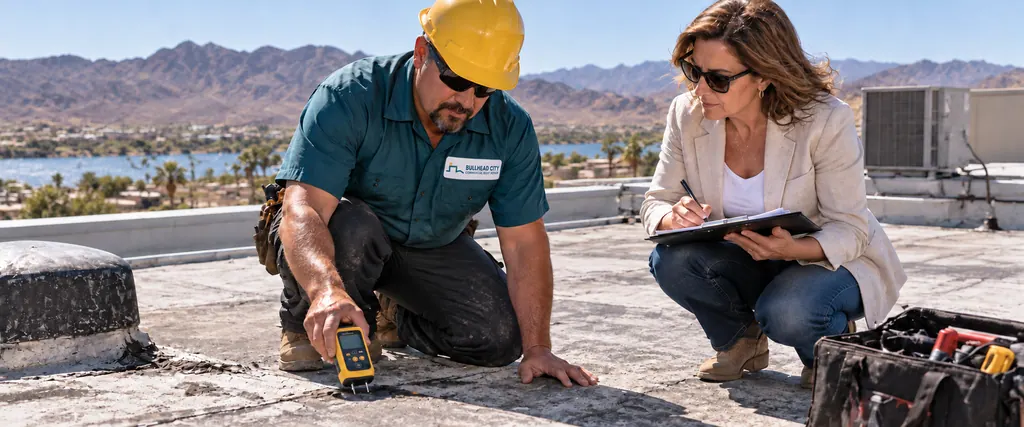
    We walk the roof above the stain and along the drainage path, check seams, curbs, and flashing, and take moisture readings near the suspected leak.

    Roofer reading a moisture meter beside a rooftop curb while a facility manager takes notes
  2. At The Building

    Match The Stain To The Roof

    Inside, ceiling stains and wet tiles get marked and photographed. Those marks are lined up with roof features so the repair targets the detail feeding them.

  3. Paperwork

    Confirm The Permit Office

    Bullhead City, Mohave County, or the Fort Mojave Building Department issues the permit, depending on the parcel. We confirm which one before cutting into membrane or flashing.

  4. On The Roof

    Remove Wet Material

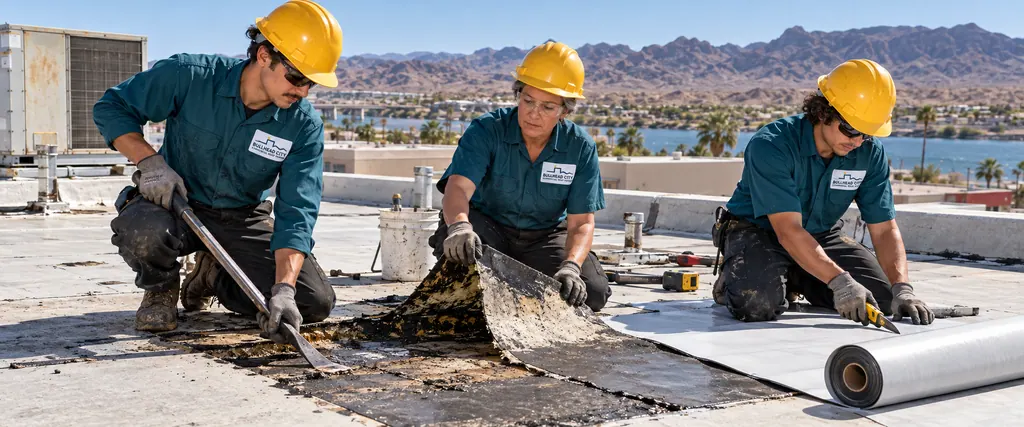
    Wet insulation and any soft deck at the leak are cut out and replaced, so the new membrane sits on a dry, firm base that holds the patch edges.

    Three roofers cutting out wet membrane and laying a new sheet on a flat commercial roof
  5. On The Roof

    Rebuild And Water-Test

    The failed seam, curb, or drain detail is rebuilt with matching material, then water-tested one spot at a time and rechecked after the next monsoon storm.

Why Repair

Benefits Of Repairing Your Roof

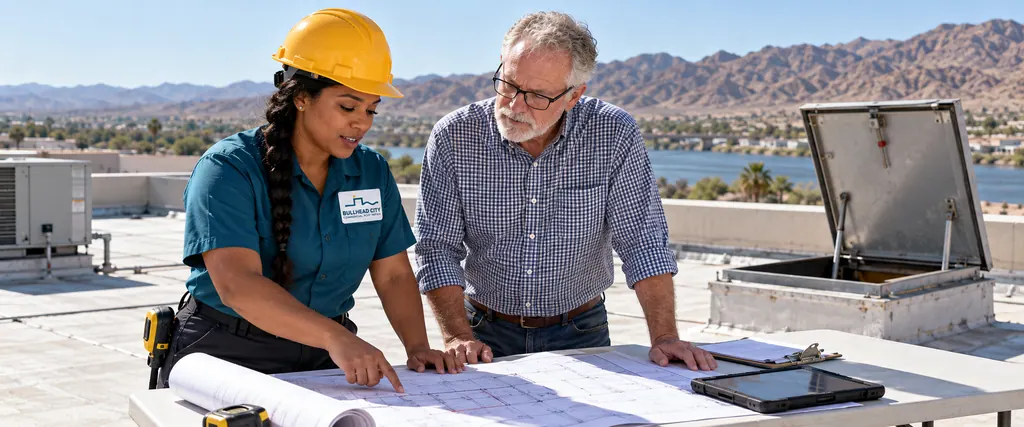
A targeted repair keeps the building dry and protects the roof you already paid for, as long as the damage stays local.

Roofer and a property owner reviewing a roof plan beside an open roof hatch

A Dry Building Below

Fixing the detail that lets water in stops ceiling stains from spreading, protects stock and equipment under the leak, and keeps wet insulation from soaking a wider area of deck.

Spend Matches The Damage

Cost follows the size of the damage and how hard it is to reach, so a curb or seam repair costs far less than a new roof.

Less Tear-Off

Only wet insulation and failed membrane at the leak come off. The dry roof around it stays in place and keeps working.

Time To Plan Ahead

Fixing the current leak gives you time to budget for a replacement on your own schedule, rather than after the next storm.

Service Area

Towns We Cover For Roof Repairs

We repair commercial roofs in Bullhead City and five communities to the south along SR 95, the Oatman Highway, and I-40.

Isometric schematic of Bullhead City and the five service areas south of it along SR 95, the Oatman Highway, and I-40, with each town shown as a small block of flat-roof buildings, not to scaleSR 68I-40Oatman HwySR 95Colorado RiverBullhead City1Riviera2Fort Mohave3Mohave Valley4Golden Shores5TopockSchematic, not to scale
  1. Bullhead City

    Primary city

    Retail and office roofs along State Route 95, with repair permits through the city.

  2. Riviera

    Southwest, inside city limits

    City permits apply here, so the permanent repair after a temporary patch goes through Bullhead City.

  3. Fort Mohave

    Down SR 95 from the city

    Strip retail roofs where a stain often sits several bays away from the seam feeding it.

  4. Mohave Valley

    Farther along SR 95

    Older steel buildings where rust bloom decides between primer and coating or a new panel.

  5. Golden Shores

    Off the Oatman Highway

    Sun-worn membrane where seam repairs come before any reflective coating decision.

  6. Topock

    At the I-40 river crossing

    Exposed roofs where gusts peel membrane and lift the wall flashing.

Roof Repair Questions

Questions Owners Ask Before A Repair

What do desert heat and monsoon storms do to a commercial roof here?

They work as a pair: months of heat open small gaps, and summer storms push water through them. Sealant at pitch pans shrinks, membrane pulls at parapets, and metal panels loosen their screws. The National Weather Service dates Arizona's monsoon season from June 15 to September 30, so a spring check finds most weak spots before the rain arrives.

Do you repair roofs on buildings that stay open?

Yes. Most repair work happens on top while tenants and staff carry on below. Noisy or odorous steps, like heat welding near an air intake, get scheduled with your manager, and any opening in the deck is covered before the crew leaves the roof so the space below stays dry.

What should I have ready before the inspection?

Know where the water shows up inside and when. Photos of ceiling stains, the dates leaks appeared, notes on recent rooftop equipment work, and any past repair records help match a stain to a seam or curb faster. Open roof access through a hatch or ladder point for the visit.

How do I know a roof is past repairing?

Look at how far the damage spreads. Wet insulation across large areas, rusted-through deck steel, or membrane cracking in the open field point to replacement. Leaks at a few seams, curbs, or drains on an otherwise healthy roof still point to repair, and a core cut settles the question when it is close.

Which roof types do you repair?

We repair TPO and other single-ply membranes, modified bitumen, and exposed-fastener and standing-seam metal roofs on commercial and industrial buildings. Each system takes its own materials and seam method, so the inspection notes the roof type and its age before any patch goes on.

How soon after a repair should the roof be checked again?

Check it after the next heavy rain, then twice a year. A spring visit catches heat damage before peak summer, and a fall visit catches storm damage once monsoon season ends. Pull blown debris from drains and scupper boxes each time, since a backed-up drain undoes a good seam repair quickly.

Get The Leak Fixed Before The Next Storm

Tell us where water is showing up and which roof it is. An inspection request is the first step toward a repair price.

Get A Free EstimateCall Us