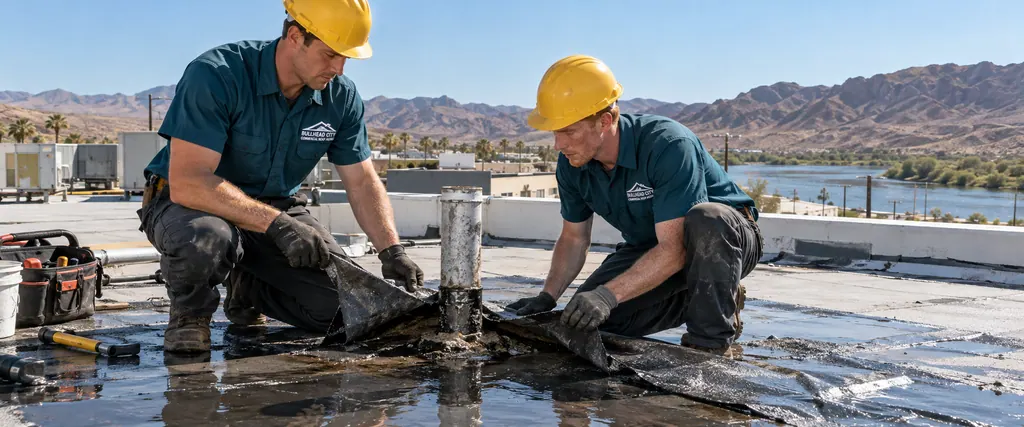
Commercial Roof Leak Repair
When a stain shows up far from any obvious seam, leak tracing follows the water along the deck before a patch goes on.
Commercial roof leak repair in Bullhead City
We repair TPO, modified bitumen, and other low-slope commercial roofs in Bullhead City, starting at the seams, drains, curbs, and wall flashing where flat roofs leak first.
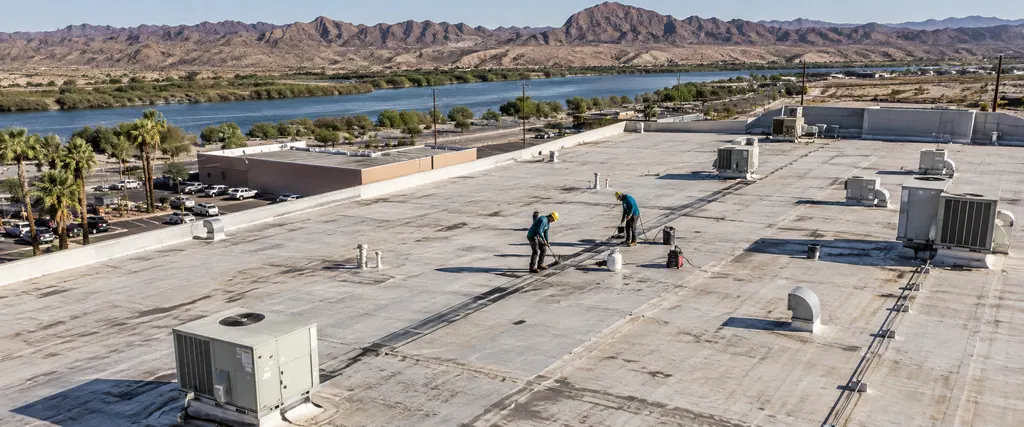
A repair lasts about as long as the membrane around it. These signs show whether your flat roof takes a patch well or needs a larger plan.
These five details account for most flat roof leaks we trace. The plan shows where each one sits on a typical low-slope roof.
A TPO lap that has opened gets cleaned, primed, and rewelded. A modified bitumen lap gets a heated or adhered strip. Either way, the edge is probed afterward to catch a cold weld.
Dust and blown trash build up in scupper boxes until water stands against the parapet. The box is cleared, and cracked sealant at its corners is cut out and replaced with matching flashing.
Curb flashing on HVAC units loosens as the unit vibrates and the sealant dries. New base flashing goes up the curb face, ending under a counterflashing or a sealed metal cap.
Split boots and pitch pans with shrunken filler send water straight down the penetration. Replacing the boot, or refilling and capping the pan, closes that path.
Membrane turned up a parapet shrinks and bridges the corner where wall meets roof. That bridge tears first, so it gets reinforced or replaced with a new flashing strip.
Each option fixes a different failure. Most visits combine two or three of them on one roof.
| Repair | What It Fixes | When It Is Enough |
|---|---|---|
| Seam reweld or strip-in | Open or cold laps on TPO and modified bitumen | Membrane next to the lap still flexes, and seams elsewhere pass a probe |
| Target patch | Punctures, cuts from foot traffic, and small split blisters | Insulation under the patch reads dry |
| Wet area tear-out | A section of wet insulation and soft cover board at a leak | Wet material stays local to that leak path |
| Detail reflash | Curbs, pipe boots, pitch pans, and parapet base flashing | The field membrane around the detail is in fair shape |
Fixing the failed details on a flat roof restores drainage and stops the leak while keeping the rest of the membrane in service.
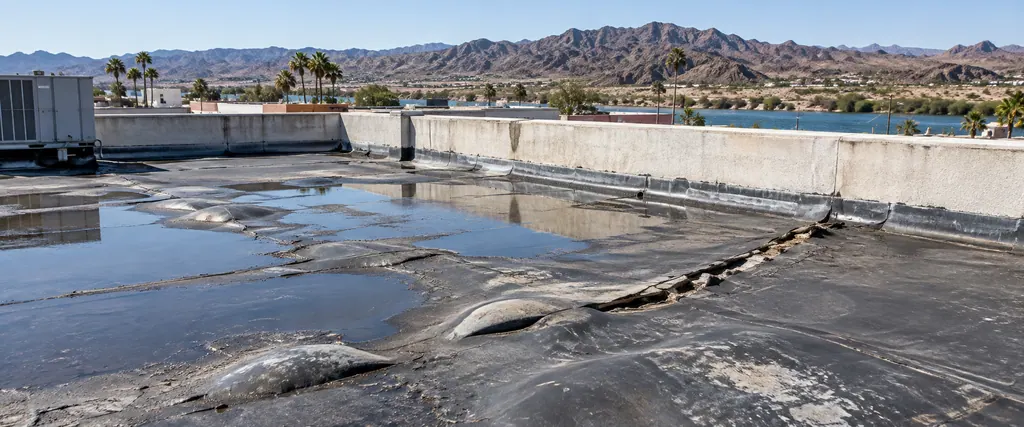
Clearing drains and scuppers and reflashing their edges lets rain run off instead of sitting against seams, which keeps the next storm from finding the same weak spot.
Rewelded seams and new flashing keep water out of the insulation, so the membrane between the details keeps doing its job for more seasons.
Repair work is priced by the details involved and the wet area removed, which keeps a seam or curb job well below the cost of a new membrane.
Most flat roof repairs happen from the roof surface, so offices and shops below stay open while the work goes on.
Blocked scuppers and drains push water into seams fast. Call and describe where it stands and how long it stays after rain.
Five steps, in the order they happen on a low-slope roof.
We walk every lap near the leak, probe welds with a seam tool, check drains and scuppers for standing water, and read moisture through the membrane around each suspect spot.
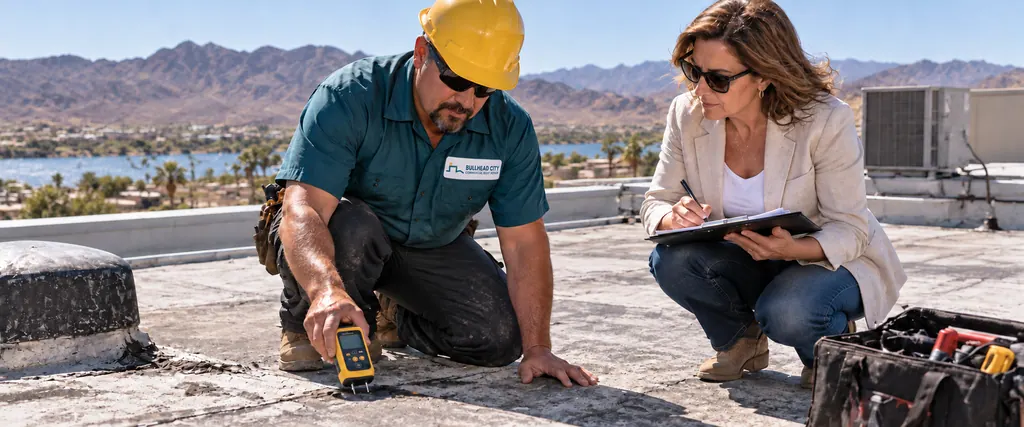
Ceiling tiles with rings, rust on a deck flute, or a damp wall along the parapet are photographed and lined up with what sits above them on the roof.
Any insulation that reads wet is cut out to the dry edge and replaced with new board, so the repaired membrane bonds to a firm, dry surface.
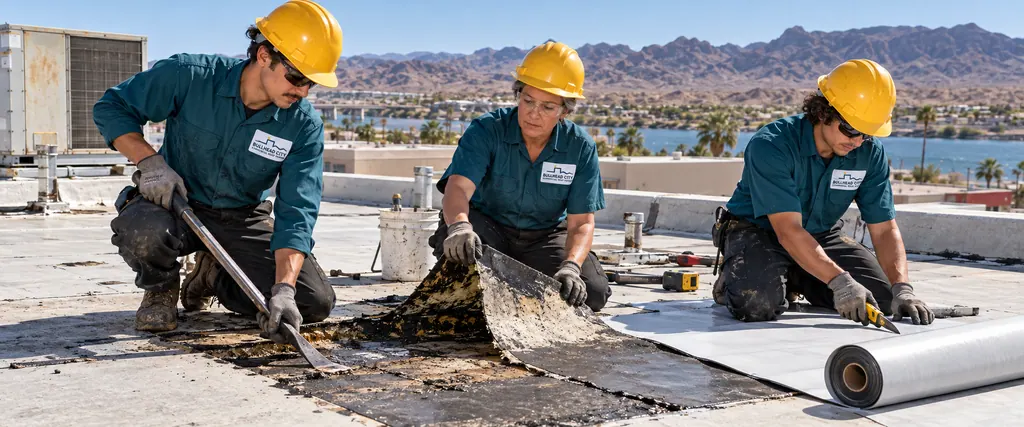
Seams are rewelded or stripped in, and curbs, boots, and parapet base flashing are rebuilt with membrane that matches the roof, so the repair moves with the sheet around it.
Each repaired detail is photographed and dated, and any area that can wait, such as a ponding spot to watch through monsoon season, is noted for the owner.
Flat roof work often leads to one of these two services.
When a stain shows up far from any obvious seam, leak tracing follows the water along the deck before a patch goes on.
Commercial roof leak repair in Bullhead City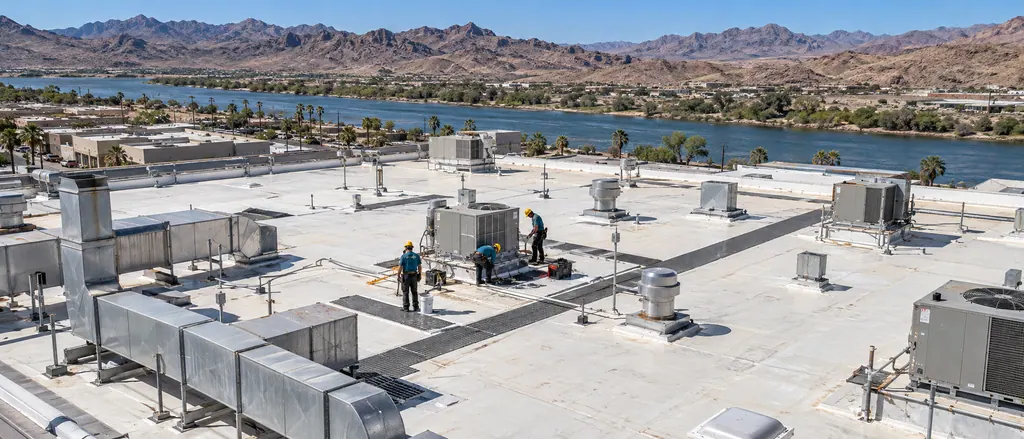
Large flat roofs over production space add exhaust curbs and skylights to the repair list, and that work gets scheduled around shifts.
Industrial roof repair for large flat roofsAt the edges and openings. Seams that lost adhesion, drains with loose clamping rings or packed dust, curbs under HVAC units, parapet caps, and sun-split pipe boots cause most leaks, while the open field rarely fails first. Long summers dry out sealant and shrink membrane at exactly those spots.
It is better to match it. TPO welds to TPO with hot air, which makes the patch part of the sheet. Tapes made for TPO work as temporary fixes, but a permanent repair uses welded TPO so it ages along with the roof around it.
Small, firm blisters away from seams are often left alone and watched. A blister that is soft, cracked, growing, or sitting on a lap gets cut open, dried, and patched, since a split blister lets water straight into the insulation below it.
Two visits a year cover most of it: one in spring before peak heat and one in fall after monsoon season. Each visit clears sediment from drains and scupper boxes, reseals cracked caulk at pitch pans and counterflashing, and records ponding rings and blisters with dated photos so changes are easy to spot.
Moisture meters and core cuts. A meter reads through the membrane to flag damp areas, and a small core cut confirms what the insulation looks like inside. Larger roofs sometimes call for an infrared scan at dusk, when wet insulation holds heat longer than dry board.
Something changed at the drain or the deck. A clogged strainer, a sagging deck section, or crushed insulation around a rooftop unit can each create a new low spot. Clearing the drain fixes the first; the other two need repair under the membrane before the ponding stops.
Send the roof type and where water shows up inside. We start with the seams, drains, and curbs above that spot.
Leave a name and number and we will call about the leak or repair. Or call now: +1 (928) 436-4825.