Industrial Roof Repair
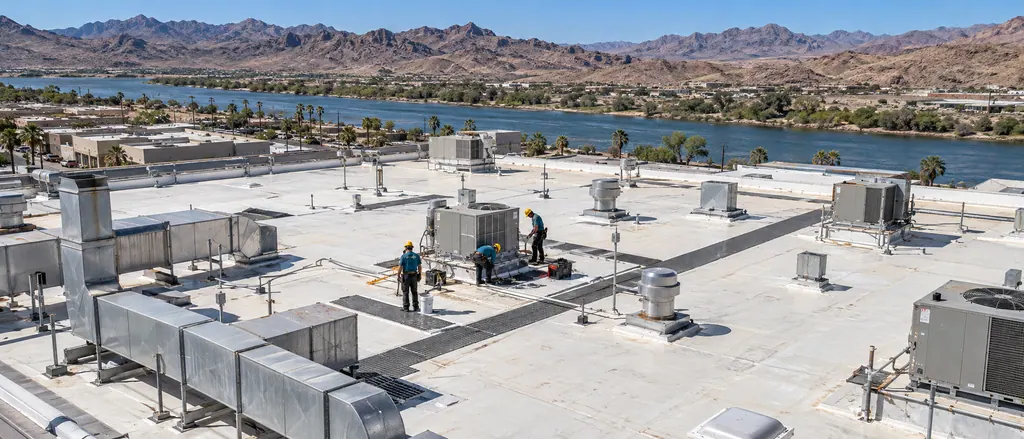
Steel buildings used for manufacturing add exhaust stacks and makeup air curbs, which are repaired around production schedules.
Industrial roof repair for production buildings
We repair commercial metal roofs, exposed-fastener and standing-seam, on Bullhead City shops and warehouses, where daily heat swings loosen screws and stretch the roof's lap sealant.
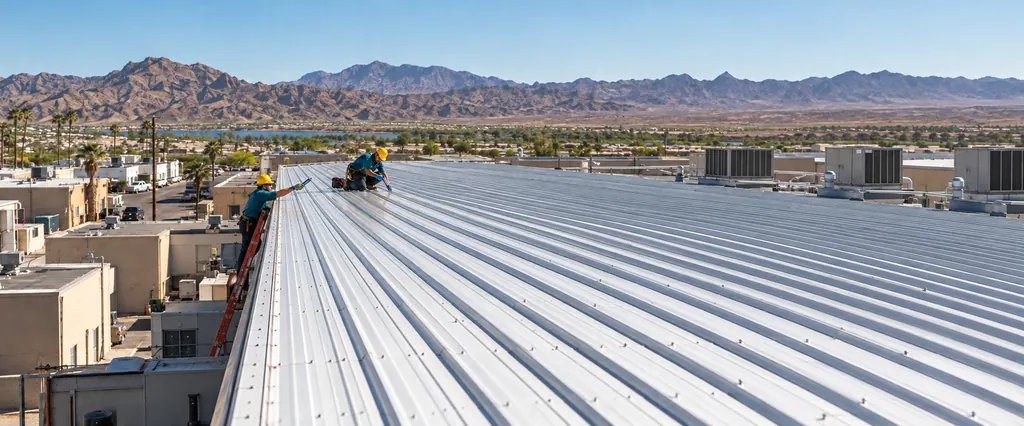
Most steel roofs have a few bad panels among many good ones. These signs sort which is which.
Fasteners and laps cause most metal roof leaks here. The plan marks five details checked on every steel roof.
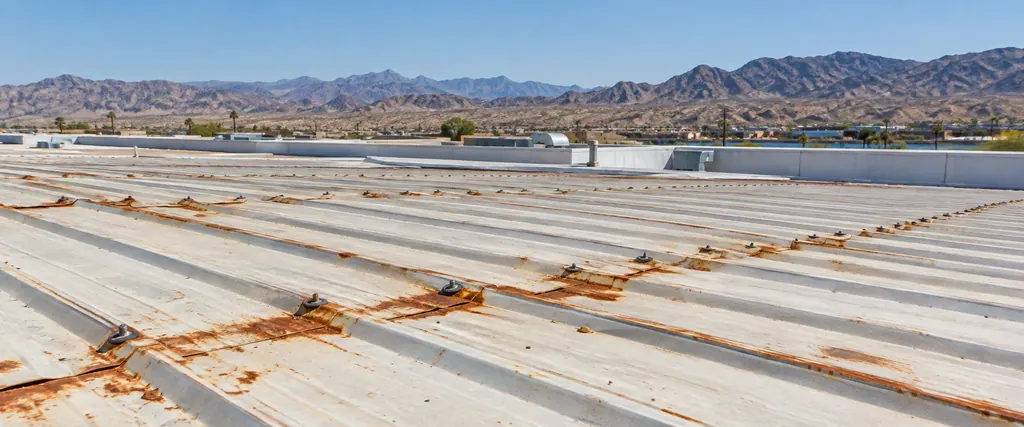
Panels grow and shrink with each hot day and cool night, working screws loose. Raised heads and cracked washers are replaced with upsized screws and new sealing washers that bite fresh steel.
Dirt lines at an end lap show where sealant has pulled apart. The lap is cleaned, resealed with butyl tape or sealant, and closed up with stitch screws.
Plastic skylight panels yellow and split in the sun. A new panel of the same profile is fastened and sealed to the metal on both laps.
Rooftop unit curbs on metal roofs need a cricket or diverter on the upslope side. Without one, water piles against the curb and finds the sealant joint.
Rubber pipe flashings with metal bases crack at the cone. A new flashing sized to the pipe, screwed and sealed to the panel, stops the drip.
Repairs on steel roofs fall into four kinds of work, often done together in one visit.
| Repair | What It Fixes | When It Is Enough |
|---|---|---|
| Fastener replacement | Raised screw heads and cracked or missing washers | Holes still grip a larger screw |
| Lap reseal and stitch screws | Dirt lines and gaps at end and side laps | Panels sit flat and tight at the lap |
| Rust prime and coat | Orange staining at screws and edges | Steel stays firm when pressed and shows no daylight |
| Panel swap | Holes, soft spots, and rust along a lap | Damage stays on a few panels |
Steel roofs hold up for decades when the fasteners and laps are kept tight. Repairs target those parts and leave good panels alone.
New screws and resealed laps stop the slow back-and-forth that widens holes, so the panels stay tight to the purlins through the next summer of heat swings.
Priming and coating light rust bloom at screws and edges stops it before it eats through, which keeps a panel swap off the list.
Only panels with holes, soft spots, or lap rust are replaced, with new fasteners and sealant at both laps.
Replacing a cracked skylight panel with a matching profile restores daylight in the shop without the drip that came with it.
Rust at a lap travels under the panel where it is hard to see. Ask for an estimate and we will check the laps before it spreads.
Five steps from the first walk on the ribs to the recheck after rain.
We walk the panels on the ribs and purlin lines, check each lap and fastener row, press on stained areas, and look for daylight from inside the building.
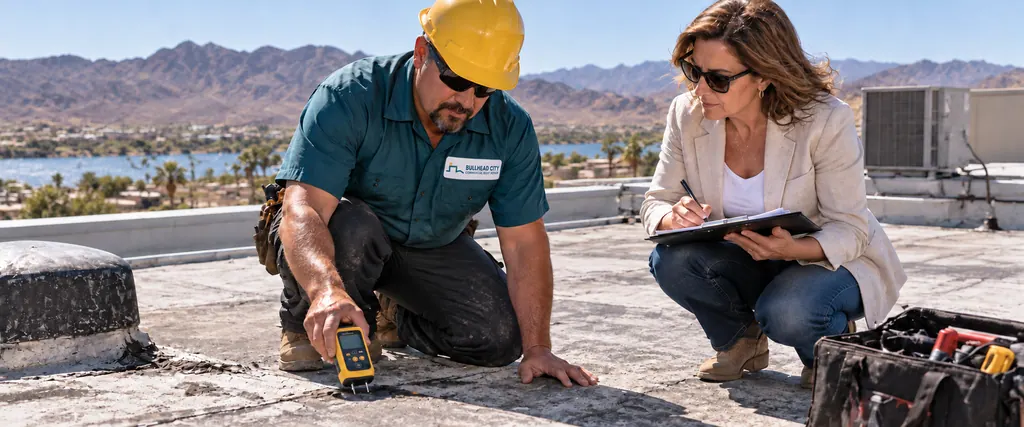
From the floor or a lift, pinholes of daylight, drips at purlins, and condensation on the underside of the panels are mapped, since condensation and a leak need different fixes.
Backed-out and stripped screws are swapped for upsized screws with new washers, driven snug so the washer seals without crushing the rubber or dimpling the panel.
End laps are cleaned, resealed, and stitched. Light rust is wire-brushed, primed with a rust-inhibiting primer, and coated, while damaged panels are swapped with new fasteners and sealant at both laps.
Each repaired lap and panel is marked on a roof sketch with photos, and the roof gets a recheck after the next heavy rain to confirm the laps hold.
Steel buildings often need one of these alongside panel and fastener repairs.
Steel buildings used for manufacturing add exhaust stacks and makeup air curbs, which are repaired around production schedules.
Industrial roof repair for production buildings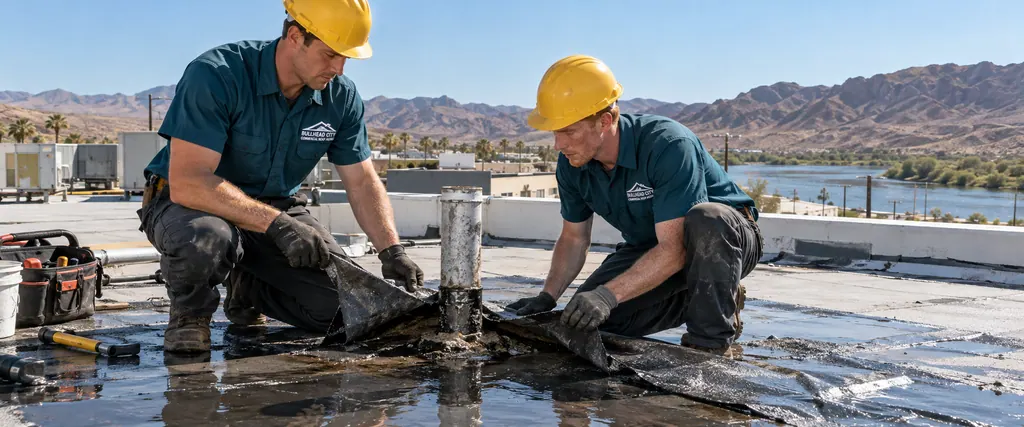
A drip at a purlin far from any rusty screw is a tracing job first, with the water followed back along the panel rib to its source.
Commercial roof leak tracing and repairFasteners and panel laps, mostly. Daily heat swings make panels expand and contract, which loosens screws and stretches the sealant at laps. Rust bloom at screws and edges and yellowed, split skylight panels round out the list on older steel buildings.
That is usually condensation. Warm, moist air inside meets the cold underside of the panel overnight and forms drops. Torn insulation facing or a missing vapor retarder is the cause, which calls for an insulation repair below instead of roof work above.
Usually one size up from the original, with a new sealing washer. The larger screw bites fresh steel around a hole that the old fastener widened over years of movement. Stripped holes in thin purlins sometimes need a new fastener location instead.
It depends on the rust. A rust-inhibiting primer and coating make sense where rust bloom is light and spread over many screws and edges. On a roof with tight laps and little rust, fastener and lap repairs alone are enough for now.
Yes. A damaged panel is unfastened, slid out from under its neighbors where the laps allow, and replaced with a new panel of the same profile and gauge. New fasteners and sealant go in at both laps so the swap seals like the rest of the roof.
Less often in the field, since standing-seam panels hide their clips. Leaks on standing seam show up at end laps, ridge and eave closures, curbs, and pipe flashings, so repairs there focus on sealant joints and trim rather than exposed screws.
Tell us the building type and where you see rust or drips. We check fasteners, laps, and skylights first.
Leave a name and number and we will call about the leak or repair. Or call now: +1 (928) 436-4825.